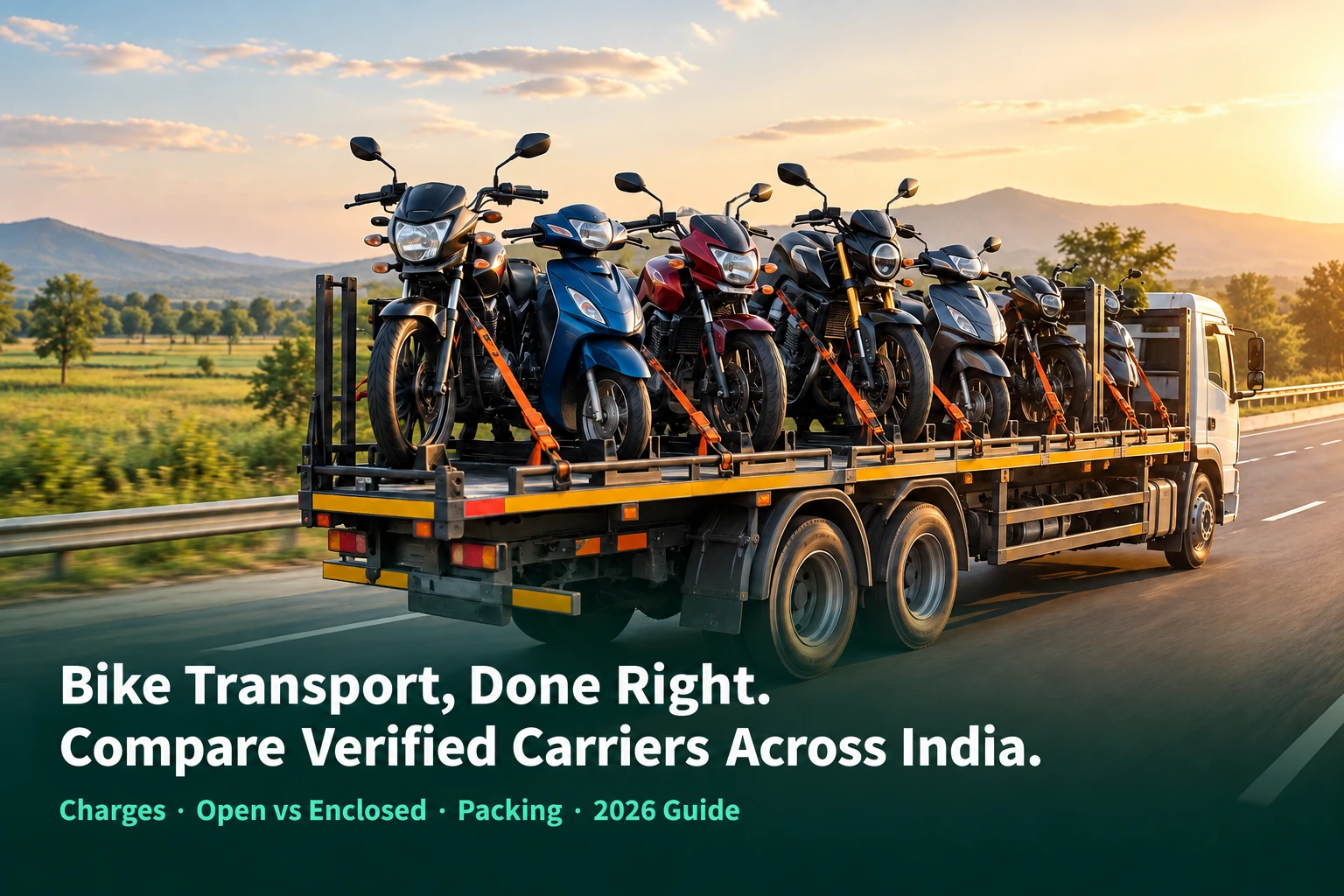
A bike is not a parcel, yet most people book its transport as if it were. They call one company, take the first price, and hope the two-wheeler arrives unscratched. Then a dent appears, or the quote climbs on pickup day, or the carrier turns out to be an open trailer in peak monsoon.
A good bike transport service removes that guesswork. It carries your two-wheeler on a proper carrier, documents its condition, insures it in transit, and delivers it on a timeline you were told in advance. This guide explains what you should actually get for your money in 2026: real charges, the open versus enclosed choice, how to pack and hand over your bike, and how to pick a carrier you can trust.
One point first. ShiftEazy is a comparison platform, not a transporter. We connect you with 1,120+ verified bike transporters through our bike transportation service, you compare their quotes, and you pay the provider you choose directly.
What a Bike Transport Service Actually Does
A two-wheeler shift has more moving parts than a courier delivery, and knowing them helps you judge a quote.
- Pickup and loading. A door-to-door service collects the bike from your address. A depot service asks you to drop it at a yard, which costs less but adds effort.
- Securing on the carrier. The bike is strapped upright with the fuel drained low, so it cannot shift or leak in transit.
- The journey. It travels on an open or enclosed carrier, usually alongside other two-wheelers, over a route the transporter plans.
- Documentation. A good provider records the bike's condition at pickup on a consignment note and offers transit insurance.
- Delivery. The bike reaches the destination address or depot, and you check it against the pickup record before you sign.
The part most people underestimate is the paperwork. With any bike transport service, the consignment note and the insurance policy are what protect you if something goes wrong, so they matter as much as the carrier itself.
Bike Transport Charges in India 2026
ShiftEazy publishes these charge bands for a bike transport service in India, and the figure depends on distance and bike type far more than anything else. No honest bike transport service quotes a flat rate before knowing your route and your bike.
|
Distance band |
Approximate charges |
|
Short routes, up to 300 km |
₹800 to ₹3,000 |
|
Medium distance, 300 to 600 km |
₹2,000 to ₹6,000 |
|
Long distance, up to 1,200 km |
₹5,500 to ₹17,000 |
Within any band, four things move the price:
- Bike type. A scooter costs less than a standard commuter bike, which costs less than a premium motorcycle such as a Royal Enfield or a KTM.
- Carrier type. An enclosed carrier adds 20 to 30 percent over an open one.
- Door-to-door or depot. Depot-to-depot cuts the cost by roughly ₹300 to ₹800 on most routes.
- Season. Summer and monsoon demand can lift rates on some corridors.
These are approximate estimates. Your actual charges depend on your bike, the route, the carrier mode and the provider you select. Get a free, personalised quote from verified transporters on ShiftEazy.
Shipping a two-wheeler soon? Compare verified bike transporters on ShiftEazy and save up to 25%. Get Free Quotes →
Bike Transport Service Charges on Popular Routes
Rates are lowest on busy corridors, where carriers run often and can fill both legs of the trip. Two of the most active are from Pune and Hyderabad.
Take Pune, one of the busiest western corridors. A two-wheeler shift from Pune to Mumbai runs about ₹1,000 to ₹3,500 for a scooter or standard bike, Pune to Goa about ₹1,800 to ₹5,000, and Pune to Bangalore about ₹3,500 to ₹8,000, with premium motorcycles such as a Royal Enfield or KTM costing more again. Short routes like Pune to Mumbai are the keenest priced because carriers run them daily and rarely travel empty in either direction. The full route table is worth comparing provider by provider before you book.
Hyderabad tells the same story in the south. Short routes such as Hyderabad to Bangalore or Hyderabad to Vijayawada run about ₹1,500 to ₹4,000, while long-distance moves to Mumbai or Delhi run about ₹5,000 to ₹10,500 depending on the bike and the carrier mode. Because this is a dense corridor with strong demand in both directions, you usually have several transporters to compare on the same route, which is what pushes the price down.
The pattern holds across the country. A high-frequency corridor gives you more carriers to compare and a better price, while a thinly served route costs more because a carrier may run back with an empty trailer. For the Pune corridors specifically, the bike transport in Pune page lists every route and rate.
Open Carrier or Enclosed Carrier
This is the choice that most affects both price and protection, so it is worth a clear decision rather than a default.
An open carrier transports your bike on an uncovered multi-vehicle trailer, exposed to dust, sun and rain. It is the lower-cost option and is perfectly fine for a standard commuter bike or scooter on a short or medium route in dry weather.
An enclosed carrier transports the bike inside a covered container, shielded from weather and road debris. It costs 20 to 30 percent more, and it earns that premium for a premium or high-value motorcycle, a long-distance route, or any move during the monsoon.
A simple rule. For an everyday bike on a short dry-season hop, open is sensible. For a Royal Enfield, a KTM or anything you would be heartbroken to see scratched, and for the rainy months, pay for enclosed.
How to Pack and Hand Over Your Bike
A professional service does the securing, but a few steps on your side prevent the most common disputes.
- Drain the fuel to near-empty. A nearly empty tank is safer in transit and is standard practice for carriers.
- Disconnect the battery. This avoids any drain or short during a multi-day journey.
- Remove or fold accessories. Mirrors, loose add-ons, phone mounts and saddlebags are easy to lose or snap, so take them off.
- Note the fuel and odometer reading. Record both before handover so there is no question later.
- Photograph the bike from every angle. Capture each panel and any existing scratch, with a timestamp. This is your evidence if damage is disputed.
- Check the consignment note. Make sure the bike's condition at pickup is written down accurately before it leaves.
Do not leave documents, a helmet or valuables in the storage box. Carry those yourself, since they are not covered by a bike's transit insurance.
How to Choose a Bike Transport Service
With many providers quoting for the same route, these checks separate a reliable bike transport service from a risky one.
- Verify the provider. Confirm the transporter is registered and insured, not just a listing. Verified bike transportation services on ShiftEazy are background-checked for documentation, insurance and service history before they appear on the platform.
- Confirm the carrier type in writing. Open or enclosed should be on the quote, not a verbal promise.
- Ask for the insurance policy, not a receipt. Check the coverage amount and the claim process before you book.
- Get GPS tracking access. On a multi-day move, a tracking link is worth more than a phone number.
- Compare at least three quotes. The spread on a single route is often wide, and comparison is where the saving and the clarity come from.
A provider that answers these clearly, and asks about your bike and route in return, is one worth booking.
When to Move Your Bike
Timing affects both price and safety. Dry months, roughly October to March across much of India, are the easiest for bike transport, and open carriers are a safe choice. During the monsoon, insist on an enclosed carrier and waterproof covering, and allow a little extra transit time for weather delays. Summer and the festive season can lift demand on some routes, so booking a week or so ahead locks in a better rate.
Documents You Need
Keep these ready for the transporter and for any state border check on a long route:
- The bike's Registration Certificate, as a copy.
- Valid insurance for the two-wheeler.
- A government photo ID.
- The signed consignment note from the transporter, plus the transit insurance policy for the move.
Carry the originals with you rather than handing them over, and keep your pickup photographs safe until delivery is complete and checked.
FAQs
1. How much does a bike transport service cost in India?
Bike transport charges range from about ₹800 to ₹3,000 for short routes up to 300 km, ₹2,000 to ₹6,000 for 300 to 600 km, and ₹5,500 to ₹17,000 for long distances up to 1,200 km. The final price depends on your bike type, the carrier mode and the route. Compare free quotes on ShiftEazy for an exact figure.
2. Is an open or enclosed carrier better for bike transport?
n open carrier costs less and is fine for a standard bike on a short, dry-season route. An enclosed carrier costs 20 to 30 percent more and is worth it for premium motorcycles, long-distance moves and the monsoon season, because it protects the bike from weather and road debris.
3. How do I prepare my bike for transport?
Drain the fuel to near-empty, disconnect the battery, remove mirrors and loose accessories, note the fuel and odometer readings, and photograph every panel before handover. Check that the consignment note records the bike's condition accurately, and carry documents and valuables with you.
4. Is my bike insured during transport?
Verified transporters on ShiftEazy offer transit insurance for the move. Ask for the policy document and the coverage amount, not just a receipt. Keep your pickup photographs as evidence, and inspect the bike against them before you sign at delivery.
5. Which bike transport routes cost the least?
High-frequency corridors are the most competitive, because carriers run often and can fill both legs. Routes from Pune and Hyderabad to nearby metros are among the busiest, so they tend to offer lower rates than thinly served routes. You can compare live route rates on the bike transport in Hyderabad page.
Ready to Ship Your Bike?
Whichever two-wheeler you are moving and wherever it is going, the routine is the same. Choose the right carrier for your bike and the season, get the condition recorded and the insurance in writing, and compare at least three verified quotes before you book. That keeps your bike move hassle-free.