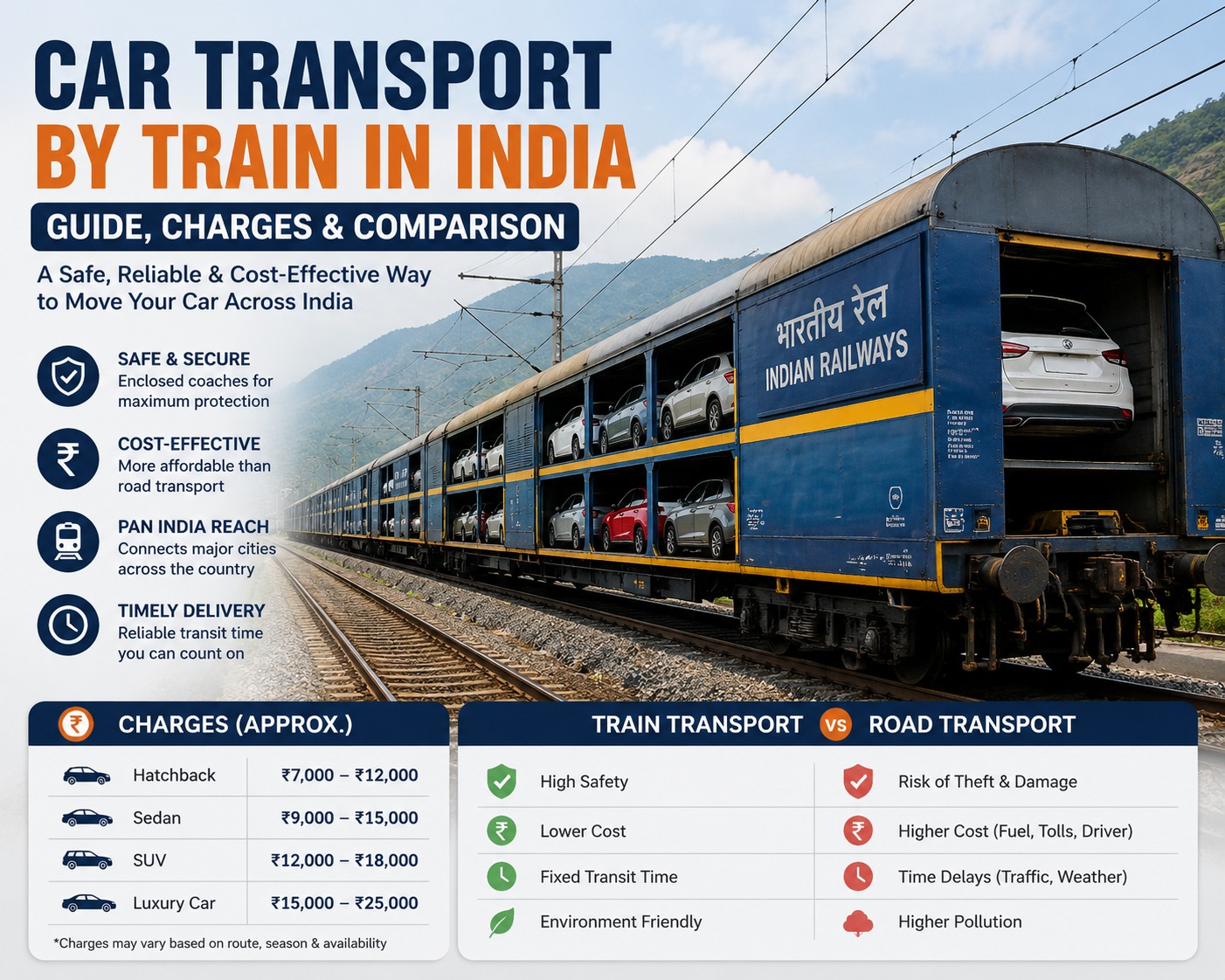
Moving your car across India can feel like a massive task. If you are shifting to a new city for a job or family relocation, you basically have two main options: sending your car by train via Indian Railways or hiring professional packers and movers to transport it by road.
For a first-time user, navigating railway stations or dealing with movers can be confusing. Let’s break down the exact process, the true costs, and a side-by-side comparison in a completely transparent, easy-to-understand way.
1. How Car Transport by Train Works in India
Indian Railways allows you to ship your vehicle through its extensive parcel network. It is one of the most budget-friendly and safest ways to transport a vehicle over long distances (greater than 800 km).
You can book your car under two different categories:
-
Car as Luggage (Baggage): You choose this if you are traveling on the exact same train to your destination. The car travels in the luggage van of your train. This is faster because the car arrives when you do, but slots are highly limited.
-
Car as Parcel: You choose this if you are not traveling on the same train, or if you are flying instead. Your car is booked at the station's parcel office and is loaded onto the next available cargo or parcel train heading to your destination.
The Mandatory Documentation
Before you head to the station, you must carry photocopies (and the originals for spot verification) of these four documents:
-
Registration Certificate (RC) of the car (proving you own it).
-
Valid Car Insurance Policy paper.
-
Pollution Under Control (PUC) certificate.
-
Government-Issued Photo ID Card (like a Driving License, PAN card, or Passport).
2. Step-by-Step Guide for First-Time Railway Users
If you choose to handle the railway process yourself, don't let the busy station environment overwhelm you. Simply follow this exact sequence:
1.Verify the Stations:1 week before.
Not every railway station has a commercial parcel office. Check the official Indian Railways Parcel Portal or visit your city’s main junction to confirm that both your originating and destination stations are equipped to handle car loading.
2.Secure a Booking Slot:3-5 days before.
Go to the railway parcel office with your documents. Fill out the vehicle forwarding note, declare the vehicle's current market value for transit insurance, pay the booking fee, and collect your Parcel Way Bill (PWB) receipt.
3.Prepare and Empty the Fuel Tank:Moving Day.
Wash your car thoroughly so pre-existing marks are clear, and take 360-degree photos. Crucial Rule: The Indian Railways strictly mandates that the car’s fuel tank must be practically empty (less than 1 to 2 liters left) to prevent fire hazards. If fuel is found during inspection, you can face structural penalties.
4.Pack and Load:At the Platform.
Private packing vendors operate right outside the parcel office. Pay them to wrap your car's headlights, bumpers, and side mirrors in scratch-resistant layers. Hand over the keys to the railway loading staff, who will secure the wheels using specialized chains and chocks inside the parcel rake.
5.Collect at Destination:Arrival Day.
Track your shipment using your 11-digit Freight Number Record (FNR). Once the train arrives, head to the destination station's luggage office, present your original Parcel Way Bill, pay minor local unloading labor charges, and drive your car out.
3. The Cost Sheet: Estimated Rail Freight Rates
Railway transport rates are highly regulated and depend mostly on the total distance traveled and the weight category of your vehicle.
| Car Segment (Examples) | Distance: Up to 1,000 km | Distance: 1,000 – 2,000 km | Distance: 2,000+ km |
| Small Hatchback (Alto, Swift, i10) | ₹5,000 – ₹7,000 | ₹7,000 – ₹9,000 | ₹9,000 – ₹11,000 |
| Mid-Size Sedan (City, Verna, Ciaz) | ₹6,000 – ₹8,000 | ₹8,000 – ₹10,000 | ₹10,000 – ₹12,000 |
| Compact/Full SUV (Creta, Scorpio, Nexon) | ₹7,000 – ₹9,000 | ₹9,000 – ₹11,000 | ₹11,000 – ₹13,000 |
| Premium Luxury (BMW, Audi, Mercedes) | ₹10,000 – ₹12,000 | ₹12,000 – ₹15,000 | ₹15,000 – ₹18,000 |
Note on Extra Costs: The rates above represent the baseline railway freight fee. You should budget an additional ₹1,500 to ₹3,000 for station packing materials, local portal labor tips, and terminal insurance premiums.
4. Train vs. Packers & Movers: Side-by-Side Comparison
While the train is incredibly cost-effective, professional packers and movers (who ship your car via specialized road car-carrier trucks) offer a completely different level of convenience. Let’s evaluate which service suits your specific situation:
| Feature | Indian Railways (Train Transport) | Professional Packers & Movers (Road Transport) |
| Pricing | Highly Budget-Friendly. Costs are roughly 40% cheaper than road alternatives. | Premium Pricing. Higher costs due to fuel, highway tolls, and dedicated truck deployment. |
| Convenience | Terminal-to-Terminal. You must drive the car to the origin station and pick it up from the destination yard yourself. | Door-to-Door. The company picks up the car directly from your current doorstep and delivers it directly to your new home. |
| Vehicle Safety | High track safety. Zero risk of road accidents or highway traffic dents, though minor scratches can happen during platform loading. | Weather & Road Risks. Subject to open highway debris, traffic bottlenecks, and monsoon waterlogging unless you buy a premium enclosed carrier. |
| Fuel Condition | Must be completely empty. You cannot leave more than a liter of fuel in the tank, meaning you have to push or tow the car to the nearest fuel pump upon arrival. | No fuel drainage required. You can leave a quarter-tank of fuel inside so the car is immediately drivable on delivery. |
| Luggage Storage | Strictly No. You cannot store a single personal item or suitcase inside the cabin due to railway security checks. | Flexible. Many companies allow you to place a few locked suitcases or lightweight boxes in the trunk or backseat. |
Final Verdict: Which One Should You Choose?
-
Choose the Train if: You are on a tight budget, your new city has a major central railway hub nearby, you are comfortable handling paperwork at the station yourself, and you want to avoid adding extra kilometers or road wear-and-tear to your vehicle.
-
Choose Packers and Movers if: Convenience is your top priority. If you do not have the time to deal with station queues, or if you need your car picked up directly from your doorstep and delivered straight to your new apartment complex without hassle, the premium cost of road transport is well worth it.