You have booked a car transporter. Your vehicle is ready. Moving day is three days away.
And then the transporter calls to say your car cannot be picked up because one document is missing.
This scenario plays out across India every single month — not because people are careless, but because the documents required for car transport in India are spread across multiple government systems, involve different deadlines, and change depending on whether you are moving within the same state or crossing a state border.
This guide gives you the complete, accurate 2026 documents required for car transport in India checklist — every document you need, why you need it, where to get it, and the specific situations where additional documents apply. Read it before your moving day, not after.
Why Documentation Matters for Car Transport
Car transport in India is governed by the Motor Vehicles Act, 1988, and its 2026 amendments. The mandatory car documents every vehicle owner must maintain include the Registration Certificate, valid insurance, PUC certificate, and driving licence — all of which are required during transport as well.
Beyond legal compliance, documentation protects you in three specific ways:
- Insurance claims: Without proper documentation — especially pre-transport photographs and a signed consignment note — your transit insurance claim can be rejected even if the damage is real
- State border crossings: Transporters crossing state borders can be stopped at checkposts. Missing documents can delay your vehicle by days
- Dispute resolution: If anything goes wrong during transport, your documentation is your only legal recourse
Section 1 – Documents You Must Provide to the Transporter
These are the core documents every car owner must hand over to the transporter — or provide copies of — to the transporter before the vehicle is loaded.
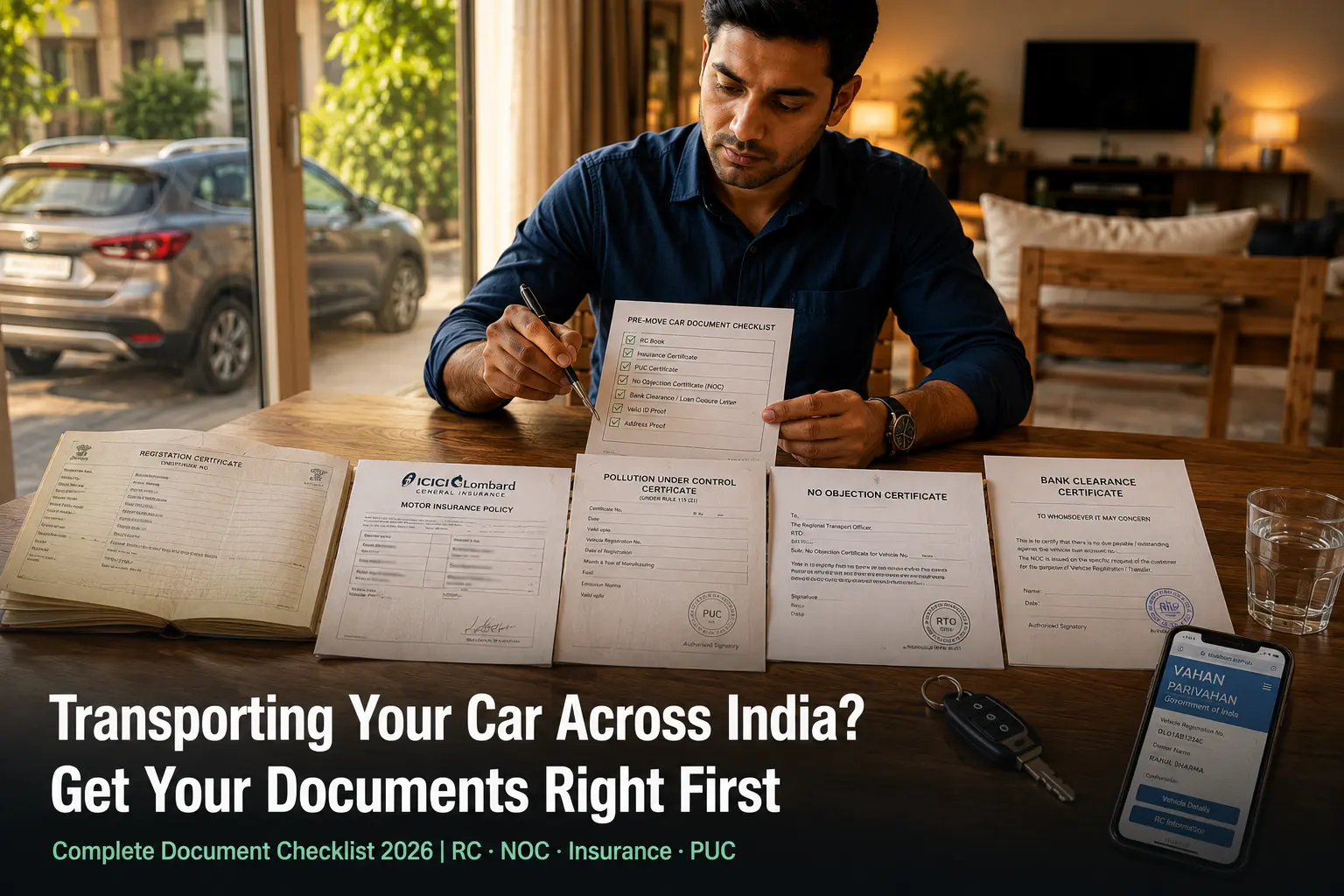
1. Registration Certificate (RC)
The RC is the single most important document for car transport. The registration certificate is an official document proving the vehicle's legal registration – it helps officials verify car ownership and ensure the car is not stolen. The RC book contains details like the owner's name and address, the vehicle's registration number, chassis number, and engine number.
What to provide: A self-attested photocopy of the RC. Keep the original with you — never hand it over to the transporter. If your RC is in the form of a smart card, carry a photocopy of both sides.
Digital alternative: Digital vehicle documents are increasingly accepted when stored on government-approved platforms. Apps like DigiLocker and mParivahan enable car owners to securely upload and access essential documents, including the RC; these digital copies are legally recognised under Indian regulations.
2. Valid Car Insurance Certificate
Your vehicle must have active insurance at the time of transport. A valid insurance certificate is mandatory — if expired, renew it first before applying for any RTO service or transport.
What to provide: A self-attested photocopy of your current insurance policy. Confirm the policy is active and covers the transport period — not just the start date.
Important: Your regular car insurance does NOT automatically cover transit damage while your vehicle is being transported as cargo. Transit damage during car transport requires a separate transit insurance policy — either purchased through your transporter or directly from an insurer like Tata AIG, ICICI Lombard, or Bajaj Allianz. Always confirm transit insurance coverage separately from your regular vehicle insurance.
3. PUC Certificate (Pollution Under Control)
A current Pollution Under Control certificate is mandatory for all RTO service applications. Transporters crossing state borders may be checked at green corridors and pollution checkpoints.
What to provide: Original PUC certificate or a clear photocopy. PUC certificates are issued at petrol stations and authorised centres across India — renewal takes under 10 minutes and costs ₹60–₹100.
4. Owner's Identity Proof
What to provide: A self-attested copy of any government-issued photo ID — Aadhaar card, PAN card, passport, or voter ID. This is required by the transporter for their consignment records and GST documentation.
5. Signed Consignment Note / Lorry Receipt (LR)
This is not a document you bring — it is a document the transporter creates and you must sign before the vehicle is loaded. The consignment note records the vehicle's condition at pickup, the origin and destination, the agreed delivery date, and the transporter's liability terms.
What to do: Read the consignment note carefully before signing. Ensure the vehicle condition at pickup — any existing scratches, dents, or damage — is accurately noted on the consignment note. Photograph every panel of your vehicle and compare against the consignment note description. If something is missing from the record, note it in writing before signing.
This document is your primary evidence in any damage or delay dispute.
6. Vehicle Photographs — Pre-Transport
Strictly speaking, this is not a government document, but it is the most important thing you can do before handing over your vehicle.
Take detailed photographs of every panel – the front, rear, both sides, roof, interior, dashboard mileage reading, and all four tyres. Photograph any existing damage clearly. Use your phone's timestamp feature. Send these photographs to yourself via WhatsApp or email immediately, creating a timestamped, cloud-stored record that is impossible to dispute.
These photographs are what determine whether a transit insurance claim is approved or rejected.
Section 2 – Additional Documents for Interstate Car Transport
If your car is crossing a state border – Delhi to Mumbai, Bangalore to Chennai, Hyderabad to Pune – you need additional documentation beyond the basics above.
7. NOC (No Objection Certificate) — Form 28
When a vehicle moves from one state to another, it needs to comply with the Motor Vehicles Act 1988. Section 47 of the Act requires vehicles staying in another state for more than 12 months to be re-registered in the new state. A No Objection Certificate from your current RTO certifies that there are no pending traffic fines or taxes, the vehicle is not under any police investigation or loan hypothecation, and it is fit for transfer.
Do you always need an NOC? No — if you are temporarily transporting your vehicle to another state (for a holiday, a short work assignment, or to sell it), you do not need an NOC. You only need an NOC if you are permanently relocating to another state and the vehicle will stay there for more than 12 months.
How to get it: Apply online at the Vahan portal (parivahan.gov.in) using Form 28, or visit your local RTO in person. Documents needed include Form 28 in triplicate, original RC, valid insurance, PUC, identity proof, address proof in the new state, and road tax clearance.
Validity: The NOC is valid for 6 months from the date of issue. You must complete the transfer process within this period or apply for a fresh NOC.
Timeline: Start the NOC process at least 2–3 months before your move date — especially if you are using packers and movers in Delhi where RTO backlogs are common. The process involves multiple steps across two RTOs and can be delayed by bank NOC processing, police clearance, or RTO backlog.
8. Bank NOC – If Your Car Is Under Finance
If your vehicle was financed, you must get a clearance certificate from the bank or financier. Many people forget to collect the Bank NOC, which causes unnecessary delays in the process — always check with your bank first if your car was financed.
Even if you have finished paying your EMIs, the bank's name stays on the RC until you formally remove it. For a car with a completed loan, you need a No Objection Certificate from the bank and Form 35 from the bank and then upload both to the Vahan portal under "Hypothecation Termination". Until you complete this, you cannot sell the vehicle or claim total loss insurance without the bank getting involved.
What to provide: The bank-issued NOC letter confirming no outstanding loan on the vehicle.
9. Road Tax Clearance Certificate
Road tax dues must be cleared in the current state before the RTO will issue an interstate NOC. The RTO verifies tax clearance before issuing NOC — outstanding traffic challans or FASTag dues can prevent the NOC from being processed.
Important 2026 update: The Central Motor Vehicles (Second Amendment) Rules 2026 now link FASTag status directly to the Vahan portal. Unpaid toll fees show up on the Vahan portal with photographic evidence from toll plaza cameras — if you have unpaid FASTag arrears, they can block your NOC for interstate vehicle transfers.
Clear all FASTag dues, outstanding challans, and road tax before applying for your NOC.
10. Re-Registration in the New State
Once your vehicle arrives in the new state — whether you used car transportation from Hyderabad or any other city — and stays there for more than 12 months, visit the local RTO and apply for re-registration. The new RTO will assign a new registration number for your vehicle and issue a fresh RC book or card.
The road tax in the new state can range from a few thousand rupees to ₹50,000 or more depending on the vehicle's current value. High-value states like Kerala, Karnataka, and Maharashtra have higher road tax rates — always check the new state RTO's road tax calculator before budgeting.
Section 3 – Special Situations
If Your Car Is Under Delhi's 10-Year/15-Year Ban
Delhi has restrictions on petrol vehicles older than 15 years and diesel vehicles older than 10 years — these vehicles cannot be refuelled or driven within Delhi. If your vehicle falls under the ban and cannot be fuelled in Delhi, arrange a verified car carrier service through ShiftEazy to move it safely to the destination state.
Documents needed: All standard documents plus proof that the vehicle is being permanently relocated out of Delhi — your NOC from the Delhi RTO is essential here.
If You Are Shipping a Financed Vehicle
You will need written permission from your financier in addition to the standard bank NOC. Some banks require a specific letter confirming the vehicle is being transported for relocation — not sold. Contact your bank's vehicle loan department at least 2 weeks before your move date.
If You Are Transporting a Vehicle You Purchased Online or Second-Hand
If you bought the car and are transporting it before the RC transfer is complete, carry:
- Original sale agreement or purchase invoice
- Form 29 and Form 30 (transfer of ownership forms)
- Previous owner's RC copy
- Your own identity proof
Without these, the transporter — and any state border checkpost — may question ownership.
Complete Document Checklist – Print This Before Moving Day
For all car transport moves (intrastate and interstate):
- RC photocopy (self-attested) — keep original with you
- Valid insurance certificate photocopy
- PUC certificate (valid and current)
- Owner identity proof (Aadhaar / PAN / Passport)
- Signed consignment note / Lorry Receipt from transporter
- Pre-transport vehicle photographs (timestamped)
- Transit insurance policy document (separate from regular insurance)
Additionally for interstate transport (vehicle staying 12+ months):
- NOC — Form 28 (from current RTO)
- Bank NOC — if vehicle is under or was recently under finance
- Road tax clearance certificate
- FASTag dues cleared (verify on Vahan portal)
- All traffic challans cleared (verify on Vahan portal)
For special situations:
- Delhi 10/15-year ban vehicles — Delhi RTO NOC confirming permanent relocation
- Financed vehicles — bank permission letter for transport
- Second-hand / recently purchased vehicles — Form 29, Form 30, sale agreement
How ShiftEazy Simplifies Car Transport Documentation
Collecting and verifying all of this documentation on your own — while also coordinating a household move or job transfer — is genuinely time-consuming.
ShiftEazy's verified car transporters are experienced in documentation requirements across all major Indian routes and state borders. When you compare car transport quotes on ShiftEazy, every transporter in our network:
- Issues proper GST invoices suitable for corporate reimbursement
- Provides a detailed consignment note before loading
- Confirms transit insurance policy document (not just a receipt)
- Has experience navigating state border requirements on high-volume routes
All transporters listed on ShiftEazy are verified for GST registration, RTO transporter licence, and insurance coverage — so you start with movers you can trust, not just movers you found first.
FAQs – Documents for Car Transport India
Q1. Is NOC mandatory for all interstate car transport in India?
No. NOC is required only if your vehicle will permanently stay in the new state for more than 12 months — such as a job relocation or permanent move. If you are temporarily transporting your car to another state and bringing it back, an NOC is not required. However, carry your RC, insurance, and PUC at all times — state border checkposts can and do verify documents.
Q2. What happens if my car insurance expires during transport?
Your transporter may refuse to load the vehicle, and state border checkposts can legally stop and detain the vehicle. Renew your insurance before your transport date — renewal takes under 30 minutes online and can be done on the insurer's app. Also confirm that your renewed insurance covers the vehicle throughout the transport period, including delivery day.
Q3. Do I need to be present when my car is picked up for transport?
Ideally yes, to sign the consignment note, verify the vehicle condition record, and hand over document copies in person. If you cannot be present, authorise a trusted representative in writing and ensure they photograph the vehicle thoroughly before the truck leaves.
Q4. Can I transport my car without the original RC?
Yes, a self-attested photocopy is acceptable for most transporters and state border purposes. However, keep the original RC safely with you. Digital RC on DigiLocker or mParivahan is also legally valid. Never give your original RC to the transporter — you will need it for re-registration in the new state.
Q5. How do I check if my FASTag dues are cleared before applying for NOC?
Log in to the Vahan portal at parivahan.gov.in using your vehicle's registration number. Check for any outstanding FASTag dues, unpaid challans, or road tax arrears under the "Check Pending Services" tab. Clear everything before submitting your NOC application — any outstanding dues will block the NOC from being issued.
Q6. How long does it take to get an NOC for interstate car transport?
The online process through parivahan.gov.in typically takes 7 to 15 working days if all documents are in order. Physical RTO visits can take 15 to 30 days depending on the RTO's backlog. Start the NOC process at least 2 to 3 months before your planned move date to avoid delays. The NOC is valid for 6 months from the date of issue.
Q7. What documents does the car transporter need for a GST invoice?
For a valid GST invoice suitable for corporate reimbursement, the transporter needs your full name or company name, your GSTIN (if billing to a company), pickup and delivery addresses, vehicle details (make, model, registration number), and service details (transport route and date). Always confirm upfront that your transporter is GST-registered and can issue a proper invoice — verify their GSTIN at gst.gov.in before booking.
Q8. What is the road tax I need to pay in the new state after interstate car transport?
Road tax in the new state is calculated as a percentage of the vehicle's current market value (IDV) and varies by state. Karnataka, Kerala, and Maharashtra charge among the highest road tax rates in India — for a mid-segment car worth ₹8 lakh, road tax in these states can range from ₹20,000 to ₹50,000. Always check the new state RTO's road tax calculator before finalising your relocation budget.
Move Your Car – The Smart Way
Documentation is the part of car transport that most people leave to the last minute. It is also the part that most frequently causes delays, disputes, and rejected insurance claims.
Start early. Verify your NOC timeline. Clear your FASTag dues. Get the transit insurance policy document. Photograph everything before handover.
And for the transport itself, compare verified car transportation in India quotes from ShiftEazy's network of 1,120+ verified providers. Every transporter is vetted for GST registration, RTO licence, and insurance coverage. Get 4 free quotes in under 2 minutes — and move your vehicle with complete confidence.